
A Jitsuin Is a Registered Seal
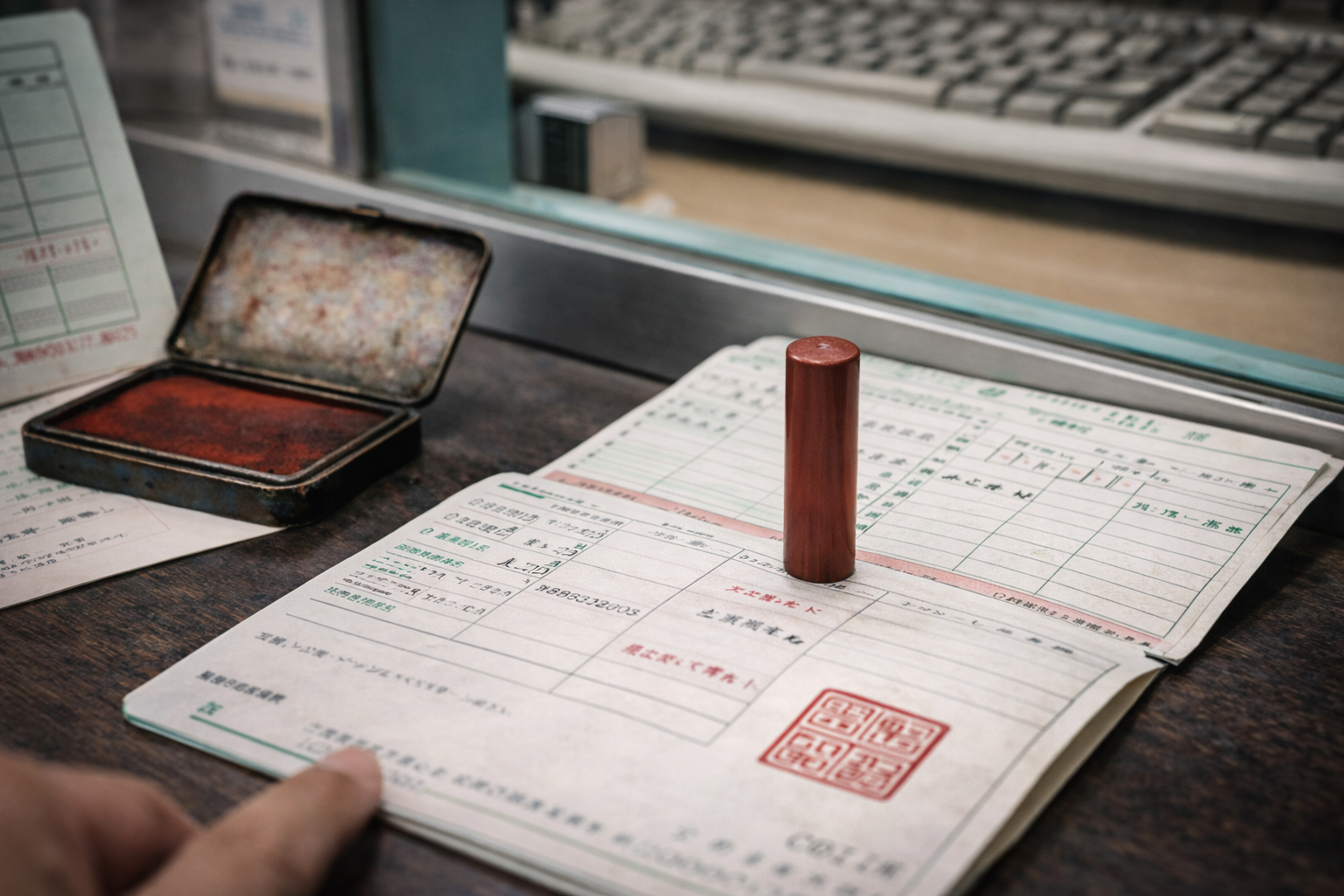
The simplest definition is this: a jitsuin is the seal a person has officially registered with the local municipality. It is different from an everyday seal used for minor acknowledgments and different again from a bank seal used for financial registration.
What matters is not only the object itself, but the fact that the seal impression is tied to an official public record. That is why the jitsuin is closely linked to the seal registration certificate.

How It Differs from Other Seals
Japan traditionally distinguishes among several kinds of seals. An everyday seal may be used for small acknowledgments. A bank seal may be registered with a financial institution. A jitsuin, however, is the seal registered with the municipality for the strongest level of ordinary personal formality.
That is why it tends to appear in transactions where the person’s intent must be confirmed with greater seriousness.
When Is a Jitsuin Used?
A jitsuin is associated with situations that are larger, heavier, or more legally sensitive than everyday office or household paperwork.
Real estate
Property-related transactions and important rights-related procedures often bring the jitsuin and seal registration certificate into view.
Inheritance and major agreements
The jitsuin is often connected to inheritance matters, formal agreements, and serious documentation involving personal responsibility.
Strong identity confirmation
The jitsuin is used where a higher level of trust is expected than would normally be associated with an ordinary seal.
Why Is It Treated So Seriously?
The seriousness of the jitsuin comes from public registration. Digital Agency materials and expert discussion documents explain the jitsuin as a seal filed with a public office, and note that when the seal impression matches the seal registration certificate, it is treated as strongly supporting the presumption that the document reflects the person’s intent. :contentReference[oaicite:4]{index=4}
So the importance of the jitsuin does not come from style or ornament. It comes from the registration-and-proof system behind it.
Is Today’s Jitsuin the Same as the Old One?
In its core function, yes. It still means the registered seal used for important acts of personal confirmation.
But its place in society has changed. Modern Japan is no longer moving toward a world where everything is stamped on paper. Instead, the jitsuin has become more concentrated in the situations that still demand heavy visible formality.

Digital “Jitsuin-Equivalent” Systems
Recent Digital Agency materials and expert discussions increasingly describe some online identity and signing functions as jitsuin-equivalent, especially where the My Number Card signature certificate is used for strong electronic identification or signing. :contentReference[oaicite:5]{index=5}
A February 2026 Digital Agency document goes further in practical business language, explaining that some electronic contracting flows can make a physical jitsuin unnecessary because they provide “jitsuin-equivalent” effect. :contentReference[oaicite:6]{index=6}
This does not mean the physical jitsuin has vanished. It means Japan is increasingly trying to reproduce the functions of the jitsuin — strong identity, non-repudiation, and visible formality — through digital systems.
Why the Jitsuin Still Remains
Even as digital identity expands, the jitsuin is unlikely to disappear immediately.
- Some legal and paper-based procedures still assume its use
- Many people still associate it with security and seriousness
- The seal registration certificate remains a strong supporting proof tool
- It still carries a clear social meaning as the person’s formal seal
In that sense, the jitsuin is still alive not only as a procedure, but as a cultural understanding of what formal consent looks like.
Today’s jitsuin is still the seal of serious intent
The jitsuin may sound old-fashioned, but its role is still clear. It is the registered seal used where personal intent must be treated with unusual seriousness.
What is changing is not the meaning of the jitsuin itself, but the rise of digital systems trying to carry that meaning into online life.